
AI use often starts with an individual. Someone opens ChatGPT or Claude, explains a situation, shares a few documents and asks for help.
That can be genuinely useful. But the context often stays in one person's conversation, notes or private workspace.
As more teams use AI, the question changes. It is no longer only, “What can this person do with AI?” It becomes, “Can people and AI systems across the business work from the same current information, decisions, processes and permissions?”
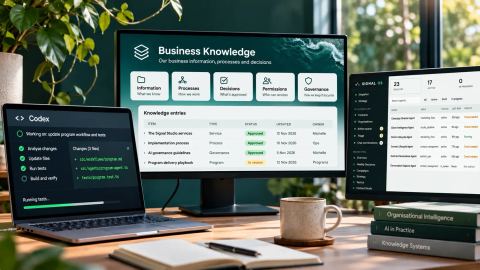
That's the shift I've been exploring through Signal OS: from individual AI use and memory to shared business context that people and different AI tools can draw on.
A clever model still needs to understand your business
A model does not automatically know which process your team follows, whether a service description is current or who has authority to approve a change.
You can explain it in one conversation, only to find yourself explaining it again elsewhere. If sales and operations work from different service descriptions, their assistants may give conflicting answers about the same business.
A business should not depend on what an AI model remembers. It should depend on knowledge the business owns, maintains and can trust.
In Signal OS, I'm designing for knowledge, decisions and instructions to be managed outside the models themselves. Different AI tools can use relevant context, but they shouldn't decide what is true or silently change what has been approved.
The business owns the context. The model uses what it needs.
Two approaches worth watching
Anthropic's research on agent memory describes agents building linked wikis from documents and prior work. In one test, wiki plus search scored 61% against 53% for search alone. But agents also overwrote important contract details when updating a shared page. Memory helped; accuracy and ownership still mattered.
Databricks' Genie Ontology enables AI agents to use shared business definitions and relationships that people can curate and govern. Instead of asking every agent to work out what the organisation means, the context can be made available to them.
These are different approaches, but they expose the same distinction: AI memory isn't automatically approved business knowledge.
What this looks like in an ordinary business
Most businesses don't need an AI-generated wiki or a major new platform to begin.
They may already have staff using AI, information across shared drives and a process that still involves copying, checking and chasing details.
That's where I'd start. Choose one business priority. Identify the knowledge, decisions and approvals it depends on. Give someone responsibility for keeping them current. Then test whether AI improves the workflow.
That's also the work we do at The Signal Studio: identifying where AI is worth using, redesigning a process and testing what works. Sometimes the first improvement is better access to information that already exists. Sometimes it includes automation or AI.
The real opportunity
We could spend the next few years giving every employee a more powerful AI assistant.
But if everything those assistants learn stays inside individual conversations, what has the business actually gained?
What becomes possible when that learning belongs to the organisation and can improve how everyone works?